A Mill Valley listing that hits the market this month will likely have an accepted offer before the open house flyers go stale. Homes here went to pending in an average of 14 days in March 2026, down from 16 days a year earlier, and across the first half of 2026 nearly half of all Mill Valley sales drew multiple offers. That speed is the story most sellers expect. What catches them off guard is the one document in the file that refuses to move at the market's pace: the city's Resale Building Report.
Every residential sale in Mill Valley requires one. It is not a form you fill out. It is a report the city prepares, and it exists specifically to flag what a seller may not know is a problem: work done on the house, sometimes decades ago, that never got a final sign-off.
What the City Actually Checks
The City of Mill Valley's own housing resources page is direct about what this report does. It notes potential illegal construction or safety concerns tied to the property, and it gets folded into the disclosure packet alongside everything else a buyer receives. That means a buyer's first look at a home's permit history often comes not from an inspector's report or an agent's summary, but from a city document assembled independently of the seller's own knowledge of the house.
The city keeps its permit and planning records in a database called eTRAKiT, searchable by address through the Property and Permit History page. Anyone can look up what has been permitted on a given lot. The Resale Building Report draws from that same record and compares it against what the city knows about the structure. Gaps between the two are what the report is built to surface.
Why Mill Valley Homes Trigger More Findings Than Most
This isn't a formality that exists everywhere. It exists here because of how Mill Valley homes actually got built.
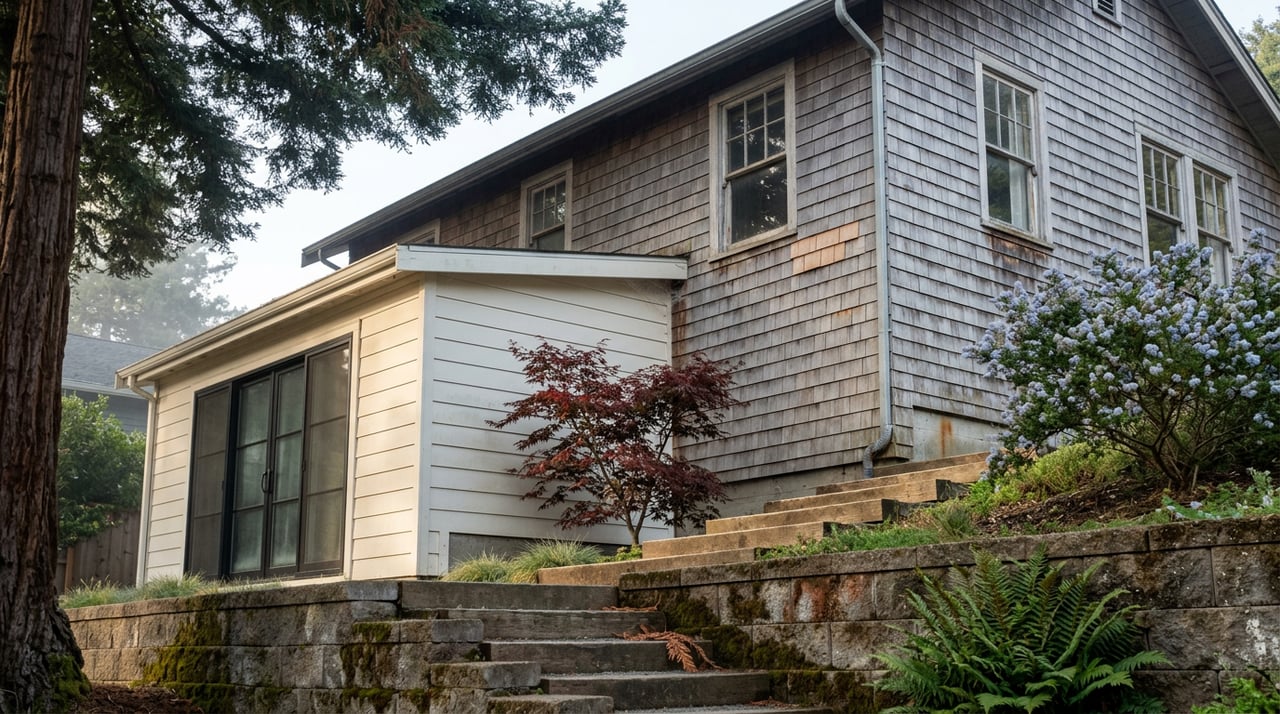
A large share of the city's housing stock predates modern permitting altogether, dating back to a run of Victorian-era construction and mid-century bungalows built when the town was still developing as a summer retreat. Owners have been adding onto, converting, and updating these houses for generations, often quietly, often without pulling a permit for a deck extension or a converted garage that felt too small a project to bother with City Hall.
Layered on top of that history is a building code that makes new permitted work genuinely harder here than in flatter towns. Mill Valley's grading ordinance requires that earthwork tied to construction be confined and reviewed specifically because the city sits on densely wooded hillsides prone to erosion and slides in heavy rain, according to the city's own grading chapter. Hillside lots typically require a soils engineer's report before any structural work can be permitted. That is a real cost and a real delay, and it is exactly the kind of friction that pushes some owners toward doing the work first and dealing with paperwork later, if at all.
The combination is straightforward. Old houses, steep lots, a permitting process with real teeth, and enough decades of ownership turnover that nobody currently living in the house necessarily knows what the last three owners built without a permit. The Resale Building Report is the moment all of that surfaces at once.
Where the Report Sits in the Timeline Matters
| Ordered before listing | Ordered after accepting an offer | |
|---|---|---|
| Who controls the narrative | Seller, with time to address findings or price around them | Buyer, reading it for the first time during their contingency period |
| Negotiating leverage | Seller can disclose upfront and set price accordingly | Findings become a credit request or a walk-away point |
| Timeline pressure | None, report runs on its own schedule | High, buyers on a 14-day-close market expect no surprises |
| Seller's options if something is flagged | Permit retroactively, disclose and adjust price, or address before photos are taken | Renegotiate under deadline, often from a weaker position |
The Clock Problem
Here is the part that catches sellers off guard. Everything else about a Mill Valley sale in 2026 has been compressing. The average sale price across Mill Valley reached $2,896,000 in the first half of the year, up from $2.6 million in the second half of 2025, with growth concentrated in the $2 million to $4 million range and real strength above $5 million. Sixty-six percent of homes sold above asking price in that same period, up from 52 percent in the second half of last year, and the average premium paid over asking climbed to 12.8 percent. Buyers are moving fast, waiving what they can, and closing on a timeline that leaves little room for anything unresolved.
The Resale Building Report does not participate in that speed. It is prepared by the city, on the city's schedule, cross-referencing records that in some cases go back decades. A seller who waits until an offer is in hand to request it is asking a municipal process to keep pace with a private negotiation, and municipal processes were never built for that. If the report turns up something once a buyer is already in their inspection window, the seller is negotiating from inside a deadline they don't control, in a market where the buyer on the other side of the table has plenty of other listings competing for their attention.
What Tends to Show Up
Based on the pattern of construction here, the most common findings are rarely dramatic. They tend to be the additions that felt minor at the time: a deck expanded without a permit, a garage converted into living space, an in-law unit added to a hillside lot without the soils report the grading ordinance would now require. None of these are unusual for a house that has passed through several owners over fifty or sixty years. What matters is that they show up in a report the buyer sees before you do, unless you look first.
Getting Ahead of It
- Pull your own permit history through the city's eTRAKiT database before you list, so you know what the city already has on file for your address.
- Compare that record against what's actually built on the property, including anything a previous owner may have added.
- Request the Resale Building Report early enough that any findings can be addressed, permitted retroactively, or priced into your listing strategy rather than negotiated under contract.
- If something surfaces that can't be resolved before listing, disclose it upfront. A known issue priced correctly moves faster than an undisclosed one discovered mid-escrow.
- Loop in your agent before you set a list price. A report with findings changes the number worth asking for, and it's better to know that before the sign goes in the yard.
A Few Questions Worth Settling Before You List
Does every Mill Valley home need a Resale Building Report, even a recently updated one? Yes. The requirement applies to residential sales generally, not just older or unrenovated homes. A recent remodel with proper permits will typically clear the report faster, but the report itself is still required.
Can a buyer request the report be pulled again during escrow, even if the seller already has one? Buyers and their agents can and often do review the underlying permit history independently through the same eTRAKiT records the city maintains, regardless of when the seller's report was ordered.
Does a flagged item always mean a price reduction? Not always. Some findings can be resolved through retroactive permitting before close. Others get addressed through disclosure and a price that reflects the work needed. Which path makes sense depends on the specific finding and the timeline the seller is working with.
How does this interact with hillside lots specifically? Hillside properties carry an added layer, since any structural work tied to grading or foundation changes on a slope may have required a soils engineer's report that wasn't obtained at the time. That combination, older construction plus hillside geology, is where findings tend to be most involved.
Selling a Mill Valley home well means understanding what the city already knows about it before a buyer does. That's the kind of preparation that turns a fourteen-day market into an advantage instead of a deadline. If you're weighing when to list, McArthur Love Team can help you pull the right records early and price with the full picture in hand. Contact us.