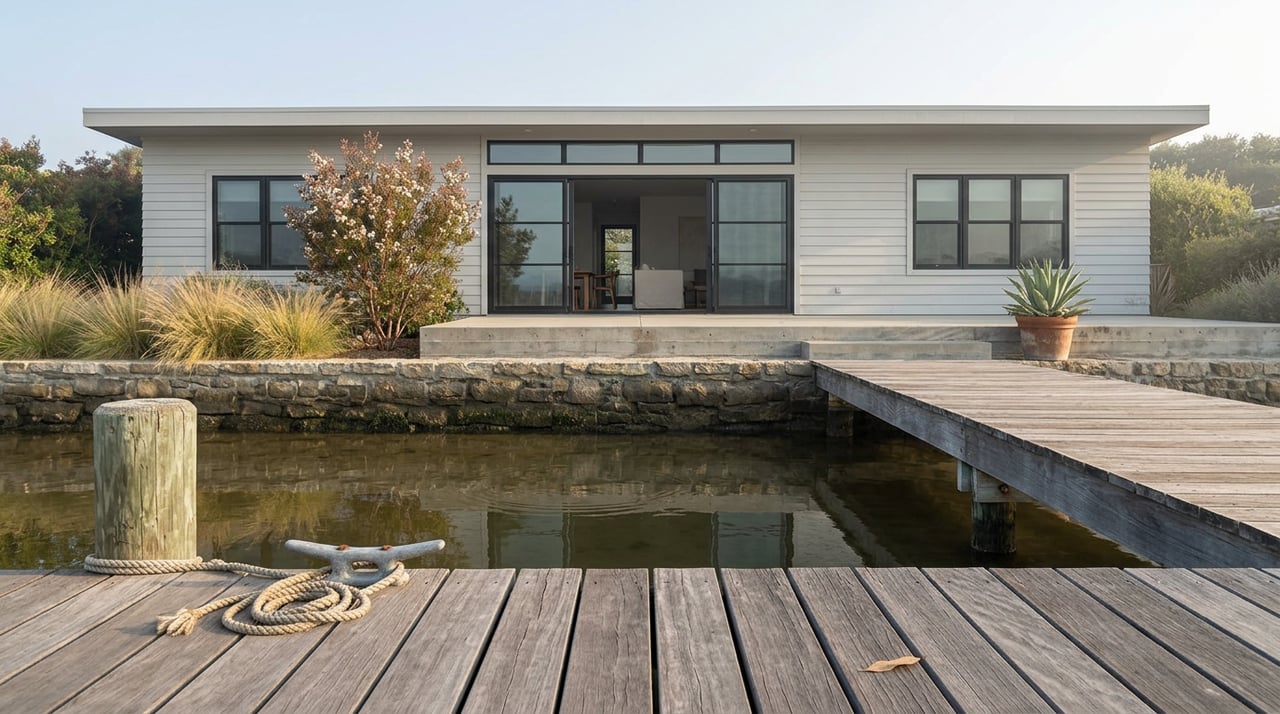
A buyer walks the back deck of a listing on one of Paradise Cay's canals, looks at the fifty-foot dock, and mentally files it under "amenities," somewhere between the outdoor kitchen and the view of Richardson Bay. Then the listing agent mentions the CSA 29 paperwork, and the buyer's face does the thing every Marin agent has seen before: the realization that the dock is not a feature of the house. It is a separate relationship with a county tax district and two permitting agencies, and that relationship transfers at closing whether anyone reads the fine print or not.
That is the piece of this market almost nobody explains before an offer goes in. A Paradise Cay dock isn't bundled into the sale the way a pool or a wine cellar is. It comes with its own tax line, its own maintenance calendar, and its own paper trail, and how well that paper trail is documented has more to do with your final price and your days on market than the square footage of the house behind it.
What Comes Attached to the Parcel, Not the Owner
Paradise Cay sits on filled tidelands developed along the east side of the Tiburon Peninsula, and most of its canal-facing homes carry a private dock as part of the property. What buyers coming from a standard Marin transaction don't always expect is that canal access itself, not boat ownership, is what pulls a parcel into County Service Area 29 (CSA 29), a special tax district the Marin County Board of Supervisors created specifically for this community.
CSA 29 exists to fund the dredging of Paradise Cay's canals and waterways, and the money for that comes from a special tax billed annually on the property tax statement. It doesn't matter whether the current owner keeps a boat at the dock or has never untied a line. If the parcel has canal access, the assessment follows the parcel, and it transfers to whoever buys the house next. A buyer who assumes the dock is simply theirs to enjoy is missing the fact that they are also inheriting a seat, however passive, in a public agency's budget.
One Channel, Two Permits, and a Clock That Keeps Running Through a Sale
Here is the part that surprises even careful buyers: the community's shared channel and an individual homeowner's private dock are permitted separately, by the same two agencies, on two different timelines.
CSA 29 itself holds long-term regional permits from the U.S. Army Corps of Engineers and the San Francisco Bay Conservation and Development Commission (BCDC) that cover the county's periodic maintenance dredging of the shared channels. That's the community-level permission. It does not extend to any individual owner's dock. If a homeowner wants to repair, rebuild, or modify their own private dock, that work requires its own parcel-specific application to both agencies, run on its own schedule and its own timeline, independent of whatever the county is doing to the channel that dock sits in.
In practice, this means a seller who replaced pilings five years ago under a proper individual permit is offering a buyer something meaningfully different from a seller whose dock has had informal repairs with no permit history at all. The house can look identical from the street. The dock's file at the county is where the real difference lives.
The Last Dredge, and What It Tells a 2026 Buyer
The most recent maintenance dredging of Paradise Cay's channels tells you roughly where the community sits in its own maintenance cycle right now.
| Detail | What the record shows |
|---|---|
| Frequency | Maintenance dredging occurs roughly every four to five years |
| Most recent project | Summer 2024, running about six weeks starting mid-August |
| Cost | Approximately $998,000, funded through the CSA 29 budget |
| Disposal site | Dredged material barged to the Alcatraz Island Disposal Site (SF-11) under Army Corps permit conditions |
That timing matters if you're evaluating a purchase in 2026. Two years out from the last round of dredging, Paradise Cay is roughly in the middle of its current maintenance cycle, which based on the county's own four-to-five-year pattern puts the next assessment-funded dredge somewhere in the back half of this decade. That's not a prediction of an exact date. It's a reason to ask a specific question before you close: what is CSA 29's current fund balance, and has any supplemental assessment been discussed for the next cycle. A buyer who asks that question is pricing the dock accurately. A buyer who doesn't is assuming the last number they saw stays flat, which it may not.
Why the Dock's Paper Trail Moves the Number
Dock homes in Paradise Cay don't sell to the same buyer pool as a comparable house without water access, and that pool narrows further depending on documented dock condition and channel access rather than square footage or finishes. A dock with clean permit history, recent maintenance records, and confirmed usable depth at low tide is a straightforward asset to underwrite. A dock with no paper trail, or one where the seller can't confirm whether past work was permitted, becomes a negotiating variable that a buyer's inspector or lender will eventually price in anyway, usually at a worse number than if it had been documented up front.
Paradise Cay's own harbor infrastructure reflects how wide that buyer range actually is. The community's yacht harbor accommodates deep-water berthing for vessels up into the range of 110 feet, which means the dock behind a given house could be serving anything from a kayak to a serious cruising boat. That range is exactly why generic comps fall apart here. A dock's specifications and its documentation determine which end of that buyer pool a given listing actually reaches.
What to Request Before You Write an Offer, or Set a Price
Whether you're the one buying or the one selling, the due-diligence list for a Paradise Cay dock home looks different from a standard Marin transaction. Before an offer goes in, or before a listing goes live, get your hands on:
- The parcel's current CSA 29 special tax amount, confirmed directly with Marin County Public Works rather than taken from a prior tax bill, since assessments can shift between cycles.
- The most recent channel condition survey and any post-dredge survey covering the canal that serves the specific dock, available through the county's CSA 29 documents page.
- Individual permit records for the dock itself, separate from the community's regional BCDC and Army Corps permits, showing whether any past repair or rebuild work was done under proper authorization.
- Maintenance history from the seller, covering pilings, decking, and any dock-mounted utilities, with dates and contractor information where available.
- Confirmed usable dock length and water depth at low tide, especially if the buyer has a specific vessel in mind, since Raccoon Strait's currents and the shallow inlets around the Cay make tide timing a real factor for larger boats.
None of this shows up in a standard title report or a generic market comp. It shows up in a phone call to Marin County Public Works and a request for the seller's own file.
A Few Questions Worth Asking Directly
Does every home in Paradise Cay have a private dock? Most canal-facing and bay-facing parcels do, but CSA 29 membership is tied to canal access itself, not to whether a dock happens to be built or in use right now.
Is the CSA 29 special tax the same for every parcel? No. It's assessed per parcel under the county's special tax structure, so the number on one house's bill is not a reliable stand-in for another's. Confirm the current figure directly rather than relying on what a neighbor or a prior owner reports.
Can a new owner opt out of paying into CSA 29? No. The assessment attaches to the parcel and runs with title, collected as part of the annual property tax bill regardless of whether the new owner keeps a boat at the dock.
A Paradise Cay dock is one of the more distinctive things Marin's waterfront market offers, and it's also one of the easiest features to misprice if you treat it like a simple amenity instead of the small regulatory and financial relationship it actually is. Getting the documentation right before you negotiate is what separates a smooth waterfront closing from one that stalls in escrow over a question nobody thought to ask in advance.
If you're weighing a purchase or a sale of a dock home on the Tiburon Peninsula, the McArthur Love Team can walk you through exactly what to request, who to call at the county, and how a specific dock's condition and paper trail should shape your number. Contact Us.